The Mountain I Had Been Warned About: My Journey to the Dent du Chat
Some mountains remain in your imagination long before your feet finally touch their paths. For me, the Dent du Chat was one of them.
I had wanted to climb it for the longest time. Its distinctive tooth-shaped summit is difficult to ignore when travelling around Lac du Bourget. It rises above the lake as though keeping watch over the towns, villages and water below. Yet whenever I mentioned wanting to hike it, the responses were almost always the same, “It is very steep.” You need to be careful.” “The final climb is not easy.”
The warnings did not make me want to abandon the idea. If anything, they made the mountain even more intriguing. Still, they stayed in the back of my mind and reminded me that this was not a hike to approach casually. I finally had my opportunity when a very good friend suggested that we climb it together.
An Early Sunday Morning in Chambéry
My friend and I met at 6:30 on Sunday morning near Au Vieux Campeur in Chambéry. We had agreed to carpool and hoped to begin walking at around 7:00 am, while the air was still cool and before the trail became crowded. I am almost always excited at the beginning of a hike. There is something about putting on my boots, carrying my backpack and leaving the ordinary rhythm of life behind that immediately changes my mood. But that morning, the excitement came with a little nervousness. I had heard so much about the Dent du Chat that the hike felt almost like a test.
As a Black African woman, I sometimes feel that people even with the best intentions underestimate my hiking experience. Perhaps they do not expect to see someone like me navigating the mountains of Savoie. I understand the value of good advice, and I never underestimate a mountain, but I also wanted the opportunity to experience this trail and decide for myself. But acknowledging their is lots to learn.
At 1,390 metres, the Dent du Chat is not particularly high compared with many of the mountains surrounding Savoie. But mountains are never defined by altitude alone. This one has steep forest paths, sections of loose ground and an exposed final climb equipped with ladders and handrails. It may be relatively short, but it demands attention. We drove to the Col du Chat, where our hike would begin, and prepared ourselves for the ascent.
Straight Into the Climb
The mountain gave us very little time to warm up gently. Almost as soon as we left the Col du Chat, the path began to climb. The morning temperature was ideal. We were mostly beneath the forest canopy, protected from the sun by the trees. Within minutes, however, our hearts were beating faster and the layers we had put on during the cool morning were coming off one by one.
I enjoy that moment during a hike when the body begins to settle into its rhythm. At first, the breathing feels loud and every incline seems to demand effort. Then, gradually, the legs understand what is required of them. The conversation finds its pace. You stop thinking about how far remains and begin to notice the forest around you. Most of this hike takes place under tree cover. The forest gave us shade and a certain feeling of intimacy, but the path was not always easy. Some sections were covered in loose soil and stones, making them surprisingly slippery. Other parts were rocky and required us to slow down and think carefully about where to place our feet.
My friend and I continued through the Forêt de Cornillon and towards the Col de la Vacherie. Sometimes we talked. Sometimes we concentrated quietly on the climb. That is one of the things I appreciate about hiking with someone whose company feels natural: silence does not need to be filled, and conversation does not need to be forced.
In the mountains, communication often goes beyond words. A glance can ask, “Are you all right?” A pause can mean, “Take your time; I am waiting.” Without discussing it, you begin to adjust to each other’s rhythm. You notice when the other person needs water, encouragement or a moment to breathe. With every metre we gained, I became increasingly curious about the final section I had heard so much about.
When Walking Was No Longer Enough
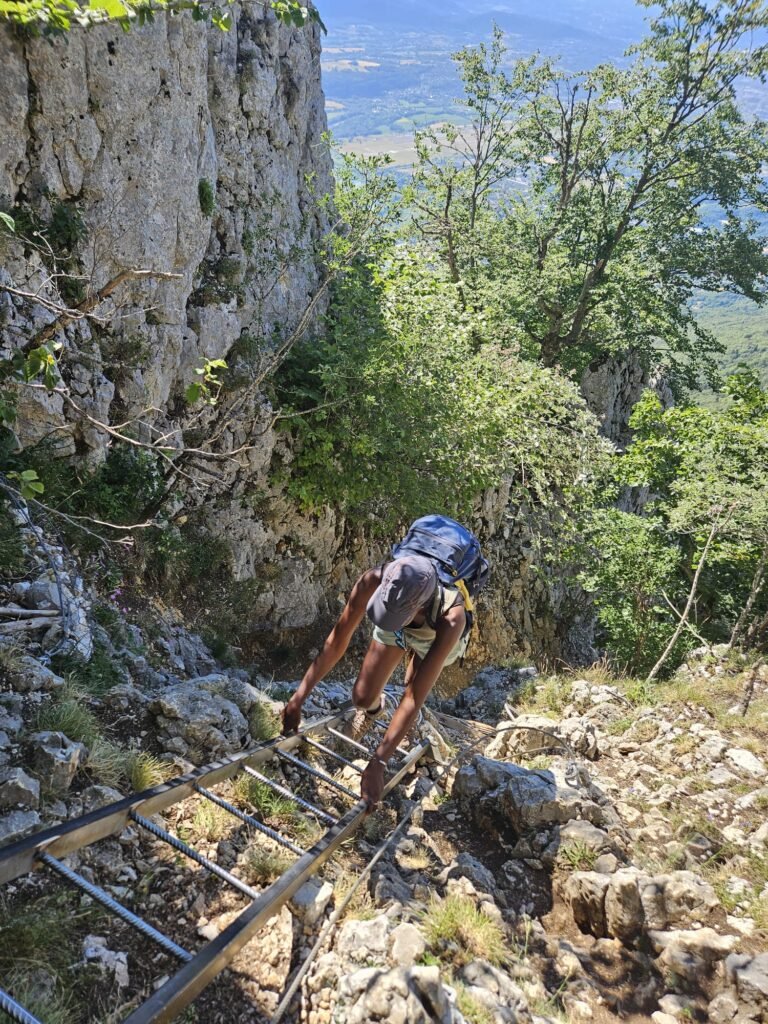
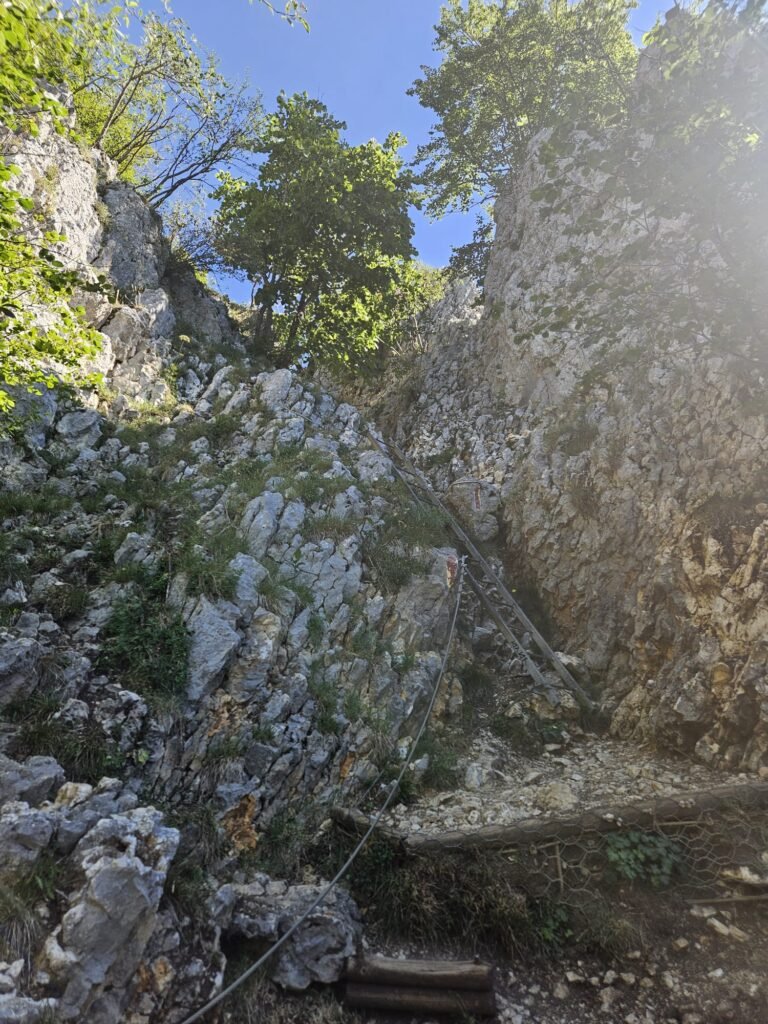
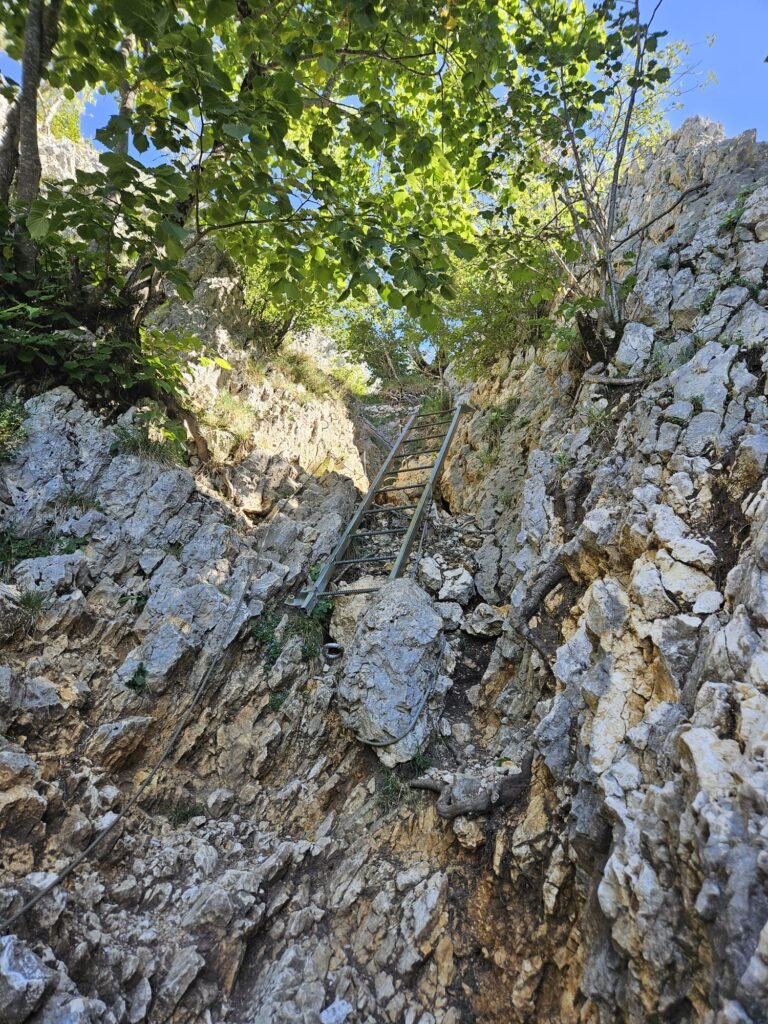
Near the summit, the character of the hike changed. The familiar rhythm of walking gave way to a much steeper and more exposed rocky passage. In front of us were metal ladders, cables and fixed handrails. From below, it looked like a small via ferrata.
It is not officially a via ferrata route, but it certainly felt like one to me. Walking was no longer enough. I needed my hands, my balance and my full concentration.Only one person could safely climb some sections at a time. We waited for each other and moved carefully, keeping three points of contact whenever possible. The ladders were secured against the rock, but there was still something unsettling about looking down and seeing how sharply the mountain dropped away beneath us.
This was where trust became especially important. My friend and I did not need to say very much. We watched one another, waited until the way was clear and made sure the other person was safely through each difficult passage before moving on. There was no pressure to climb quickly and no judgement when one of us needed an extra moment.
The mountain required us to respect not only the terrain but also each other’s pace. I felt a mixture of excitement and nervousness. This was the part people had warned me about, and now I finally understood why. It was manageable in the dry summer weather, but there was no room for carelessness. At the same time, it was the most thrilling part of the experience. There are moments in the mountains when you become completely present. You are no longer thinking about yesterday, tomorrow or anything waiting for you at home. Your entire world becomes the next rung of the ladder, the next secure handhold and the next deliberate movement.
One step. One breath. One hand at a time. Then, almost unexpectedly, we reached the top.
The Lake Beneath Us
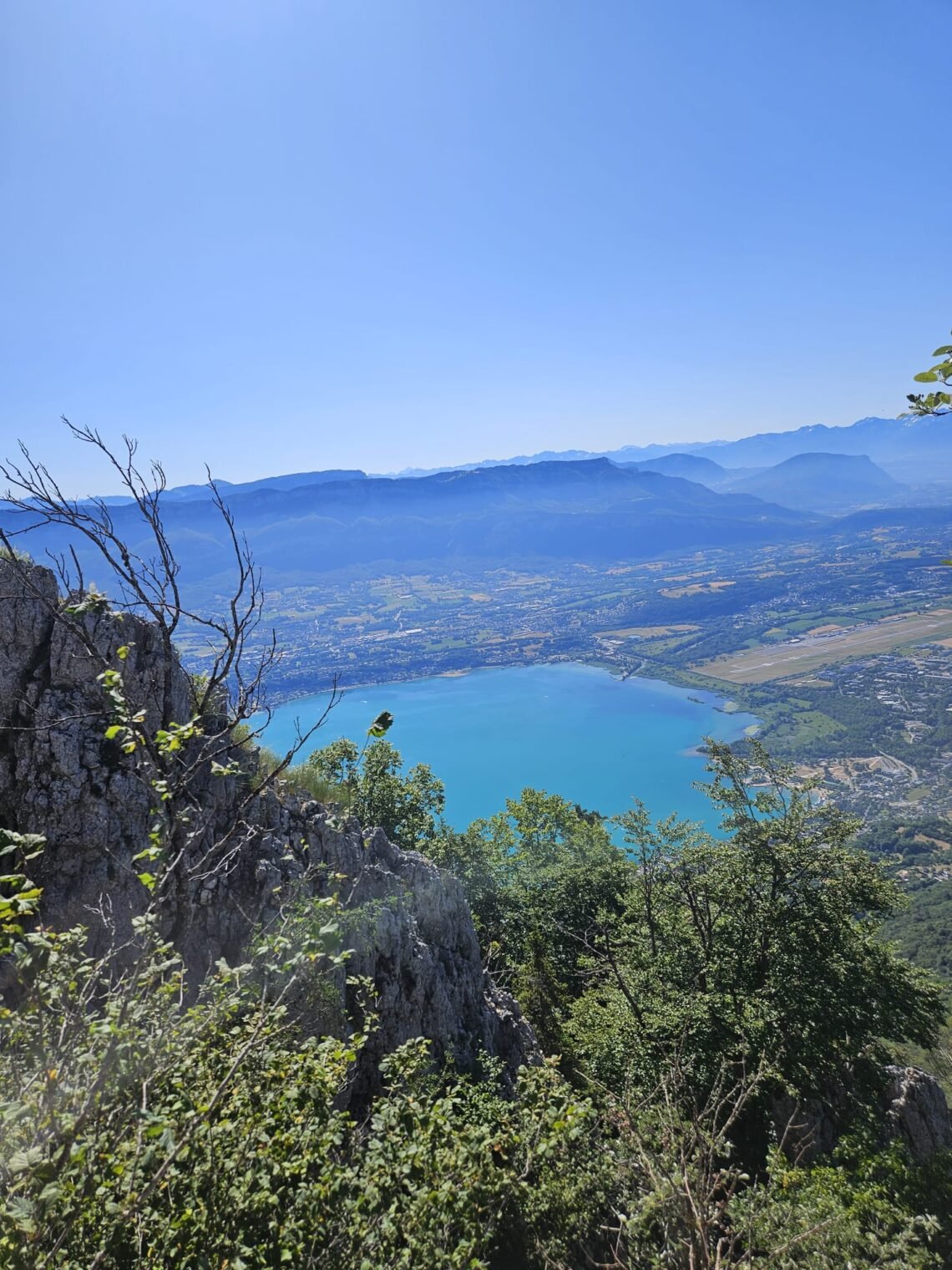
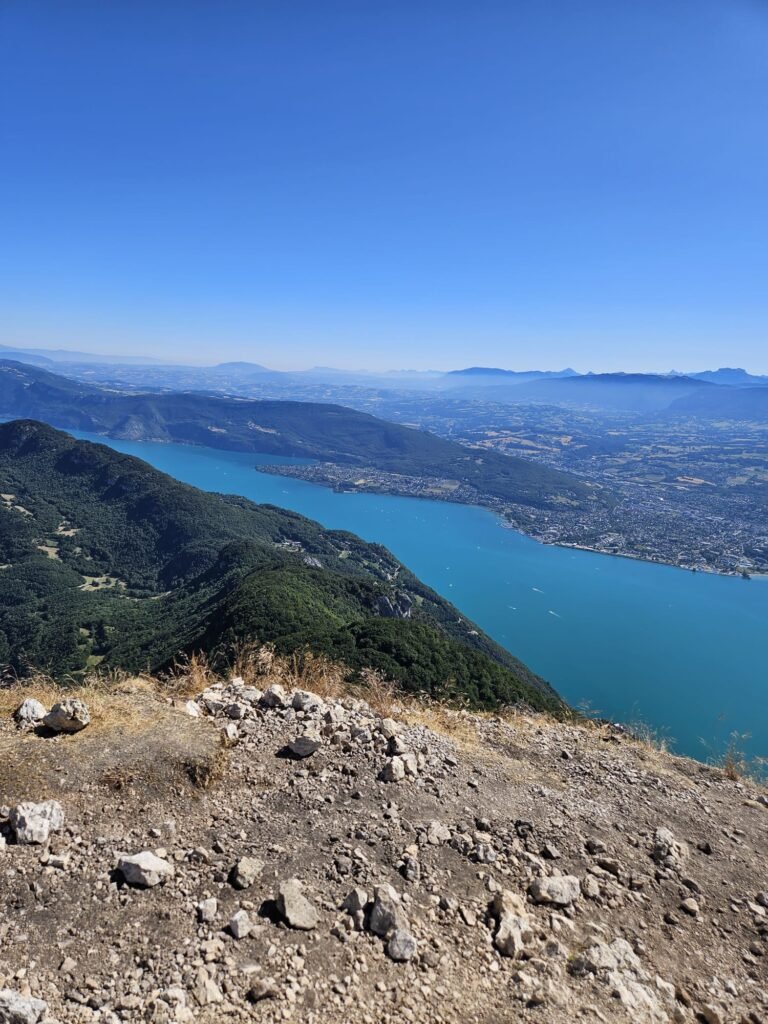
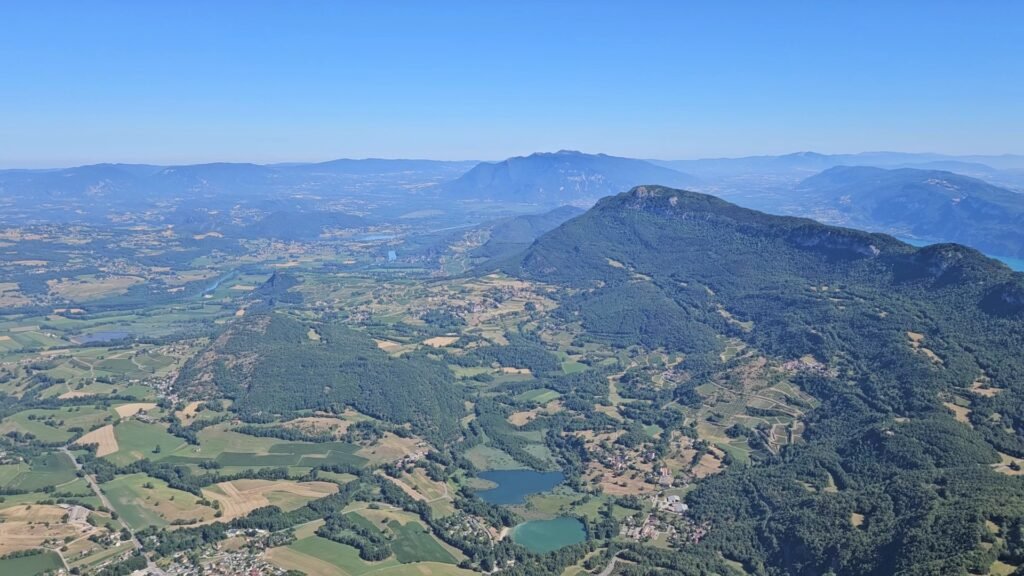
The forest opened and Lac du Bourget appeared below us, vast, blue and almost impossibly beautiful.
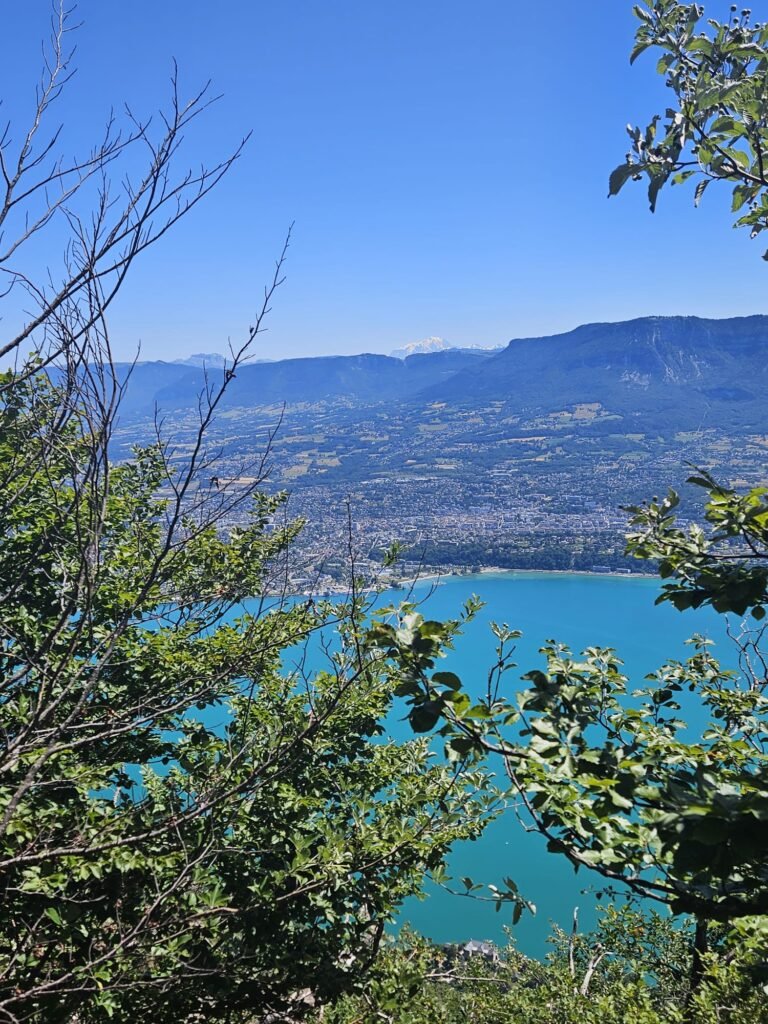
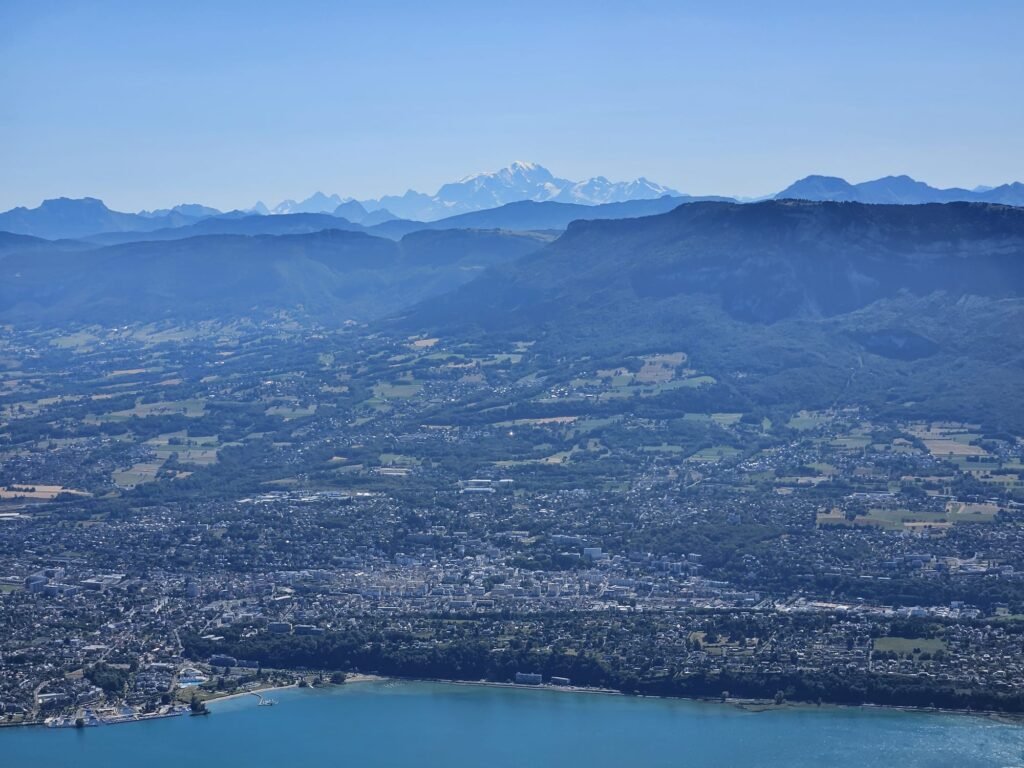
Aix-les-Bains stretched along the opposite shore. Chambéry and the surrounding countryside lay beyond the lake, while layers of mountains faded into the distance. From the small rocky summit, the landscape appeared to unfold in every direction. On a clear day, it is possible to see the Jura, the Bauges, Belledonne, the Beaufortain, the Vanoise and even Mont Blanc. We were fortunate to have clear blue skies, and the lake shone beneath us in shades of turquoise and deep blue.
The photographs are beautiful, but they cannot fully capture what it felt like to stand there. They show the water, the cliffs and the distant mountains, but they cannot record the relief after the climb, the breeze against our skin or the happiness of finally reaching a place I had imagined for so long.
We were also incredibly lucky. When we arrived, we had the summit entirely to ourselves. For nearly twenty minutes, there was no one waiting behind us and no need to hurry. We could breathe, look around and take in the enormity of the view. After the concentration required by the final climb, that quiet felt like its own reward. Soon, other hikers began to arrive. The summit is small, and it quickly became clear why starting early had been such a good decision. We greeted one another and made space so that everyone could arrive safely and enjoy the view.
There is a particular courtesy among hikers. Most people say hello, exchange a few words about the route or warn others about a difficult section. On narrow passages, strangers wait for one another and indicate when it is safe to continue. These may be brief encounters, but they create a temporary community held together by respect for the mountain and responsibility towards one another. As the summit grew busier, we knew it was time to begin our descent.
A Mountain Wrapped in Legend
Standing on that pointed summit also made me curious about its unusual name.The Dent du Chat lies on the Mont du Chat ridge in the southern part of the Jura massif. Although it overlooks the Alpine landscape of Savoie, it is geographically part of the Jura. Its sharp limestone profile resembles a tooth, but local legend offers a much more dramatic explanation.
The story tells of a fisherman who promised God his first catch. When he pulled a small black kitten from the water, however, he failed to honour his promise and took the animal home. The kitten eventually grew into a terrifying creature known as the Chapalu, which attacked people travelling across the mountain.In the medieval Arthurian tradition, the monster was eventually defeated by King Arthur. According to local versions of the legend, the cat lost a tooth during the battle, and that tooth became the summit overlooking Lac du Bourget.
The Summit Is Only Halfway
Reaching the top brought relief, but the hike was far from finished. We still had to descend the same ladders and rocky passages we had climbed. Going down felt more intimidating than going up. When climbing, I had mostly been looking at the rock in front of me. During the descent, I had to look down, search for each rung and lower myself carefully towards the drop below.
Once again, we moved one at a time. A word, a gesture or a reassuring glance was enough to guide us. When we met hikers climbing towards the summit, we communicated about who should move first and waited patiently for one another to pass. On a mountain, moving slowly is not a weakness. Sometimes it is the wisest decision you can make. Respect means allowing others to find their own pace instead of making them feel hurried or inadequate. It also means warning those below if a stone becomes loose and making space where the path is narrow.
Below the equipped section, the forest path continued to demand our attention. The loose earth and small stones that had been challenging during the ascent felt even more slippery going down. We placed our feet carefully and took our time. Eventually, we found a peaceful place beneath the trees and stopped for our picnic. We removed our backpacks, rested our legs and allowed the intensity of the climb and descent to settle.
Food always seems to taste better after a mountain effort. Perhaps it is the hunger, the fresh air or the satisfaction of having earned the moment. We sat there tired, happy and grateful for the good weather, for each other’s company and for everything the mountain had given us that morning.
For a long time, the Dent du Chat had been a mountain I knew mainly through other people’s warnings. By the time we returned to the Col du Chat, it had become part of my own story.
What the Dent du Chat Taught Me
Since moving to Savoie, hiking has become one of the ways I discover this part of France. Every trail reveals something new, not only about the landscape but also about myself. The Dent du Chat reminded me that warnings are not always intended to prevent us from doing something. Sometimes they teach us to prepare properly, respect the challenge and understand our limits. I was right to take this mountain seriously. The steep paths, exposed ladders and slippery descent required concentration. But I was also right not to allow the warnings to stop me.
It also reminded me that although hiking can be an individual challenge, we rarely experience the mountains entirely alone. We depend on the person beside us, on communication that is sometimes spoken and sometimes silent, and on the consideration of strangers sharing the same path. The mountains build trust because they ask us to pay attention to the terrain, to ourselves and to one another. They teach us that independence does not mean refusing support. Sometimes strength is knowing that someone is watching over you and making sure they know that you are watching over them too.
Courage in the mountains does not mean feeling no fear. It means recognising that fear, preparing carefully and continuing at a pace that feels safe. That Sunday, the Dent du Chat gave me cool forest paths, nervous laughter, moments of intense concentration and one of the most beautiful views I have experienced over Lac du Bourget.
Most of all, it gave me the satisfaction of finally standing on a mountain I had spent so long looking at from below and of reaching it beside someone I trusted.
Practical Information
- Starting point: Col du Chat
- Summit altitude: 1,390 metres
- Starting altitude: Approximately 638 metres
- Distance: Approximately 7 kilometres return
- Elevation gain: Around 800 metres
- Walking time: Approximately five hours, depending on pace and breaks
- Difficulty: Moderate to demanding
- Route: Col du Chat–Forêt de Cornillon–Col de la Vacherie–Sous la Dent du Chat–Carrefour des Quatre Sentiers–Dent du Chat
- Return: Along the same route
- Main challenges: Sustained ascent, loose ground, slippery sections, exposed rocky passages, ladders and fixed handrails
The trail is well marked, but having an offline map is still advisable. An alternative, shorter approach is possible from the Relais du Mont du Chat via Molard Noir, although the exposed final climb remains the same. The Dent du Chat may not be Savoie’s highest mountain, but it is certainly one that deserves preparation, patience, trust and respect.
Attempt the hike in dry and stable weather. Wet rock and loose earth would make both the ascent and descent considerably more dangerous. The final section may not be suitable for people with a strong fear of heights, and additional care is necessary when the small summit becomes crowded.


You May Also Like
Winter Break Between the French Alps and Alsace
Discovering the French Mountains as an African.